RankYak vs Autoblogging.ai for Keyword Research
You are comparing two tools for the same job, and the wrong pick costs you hours every week. Keyword research is where that decision gets made, because it feeds every article you publish next.
By the end, you will know how Autoblogging.ai and RankYak handle SERP competitor analysis, LSI keyword extraction, bulk generation, and one-click WordPress publishing. You will also see both pricing models side by side and get a clear verdict on which tool fits your workflow.
Quick Verdict: RankYak vs Autoblogging.ai for Keyword Research
For most businesses seeking an all-in-one keyword research and content automation platform, Autoblogging.ai offers a more comprehensive solution than RankYak. RankYak has earned attention for its keyword research focus, and teams that only need to uncover keyword ideas may find it useful. But keyword research is only the starting line. The real work begins when you turn those keywords into published content that ranks.
That gap is where Autoblogging.ai pulls ahead. It pairs SERP competitor analysis and semantic SEO tools with bulk generation, so a keyword list does not sit idle in a spreadsheet. Instead, it feeds directly into article production. For anyone weighing SEO tools on end-to-end value, that combination matters more than a slightly deeper research view.
Here is how the two stack up on the factors that decide most buying decisions:
| Factor | Autoblogging.ai | RankYak |
|---|---|---|
| Primary strength | Keyword research plus full content automation | Keyword research |
| SERP competitor analysis | Included | General research features |
| Content generation | 10+ AI modes, 35+ languages | Limited content generation |
| Publishing | One-click WordPress publish | Not a core focus |
| Scale | Bulk generation, 1M+ articles generated | Research-oriented workflow |
| Track record | Trusted by 40,000+ content creators, 4.9 average rating | Smaller user base |
| Support | 24/7 support, credits rollover | Varies by plan |
The table tells a simple story. RankYak helps you find opportunities. Autoblogging.ai helps you find them and act on them without stitching together separate tools. Its 35+ integrations and one-click WordPress publish remove the manual handoffs that slow most content teams down.
A few more details round out the verdict. Autoblogging.ai ships new features weekly, includes a human proofreader in all plans, and applies a 21-point SEO audit alongside featured snippet optimization. Credits roll over, which suits teams with uneven publishing schedules. None of these are research-only features, and that is the point: research is one part of a larger workflow the platform already covers.
RankYak is not without merit. If your only goal is gathering keyword ideas and you already have a separate content pipeline, a research-first tool can fit. The trade-off is fragmentation. You still need a writing tool, a publishing path, and a way to keep quality consistent across languages and formats.
For readers who want keyword research and content automation in one place, the recommendation is clear. Autoblogging.ai is the stronger choice for end-to-end automation, backed by a 4.9 average rating and a user base of 40,000+ content creators. Choose RankYak only if research alone is genuinely all you need.
At a glance: how Autoblogging.ai compares to RankYak, Autoblogging.ai for Keyword Research on the features that matter most.
| Feature | Autoblogging.ai | RankYak | Autoblogging.ai for Keyword Research |
|---|---|---|---|
| Keyword Research | ✓ | ✓ | ✓ |
What Is Autoblogging.ai?
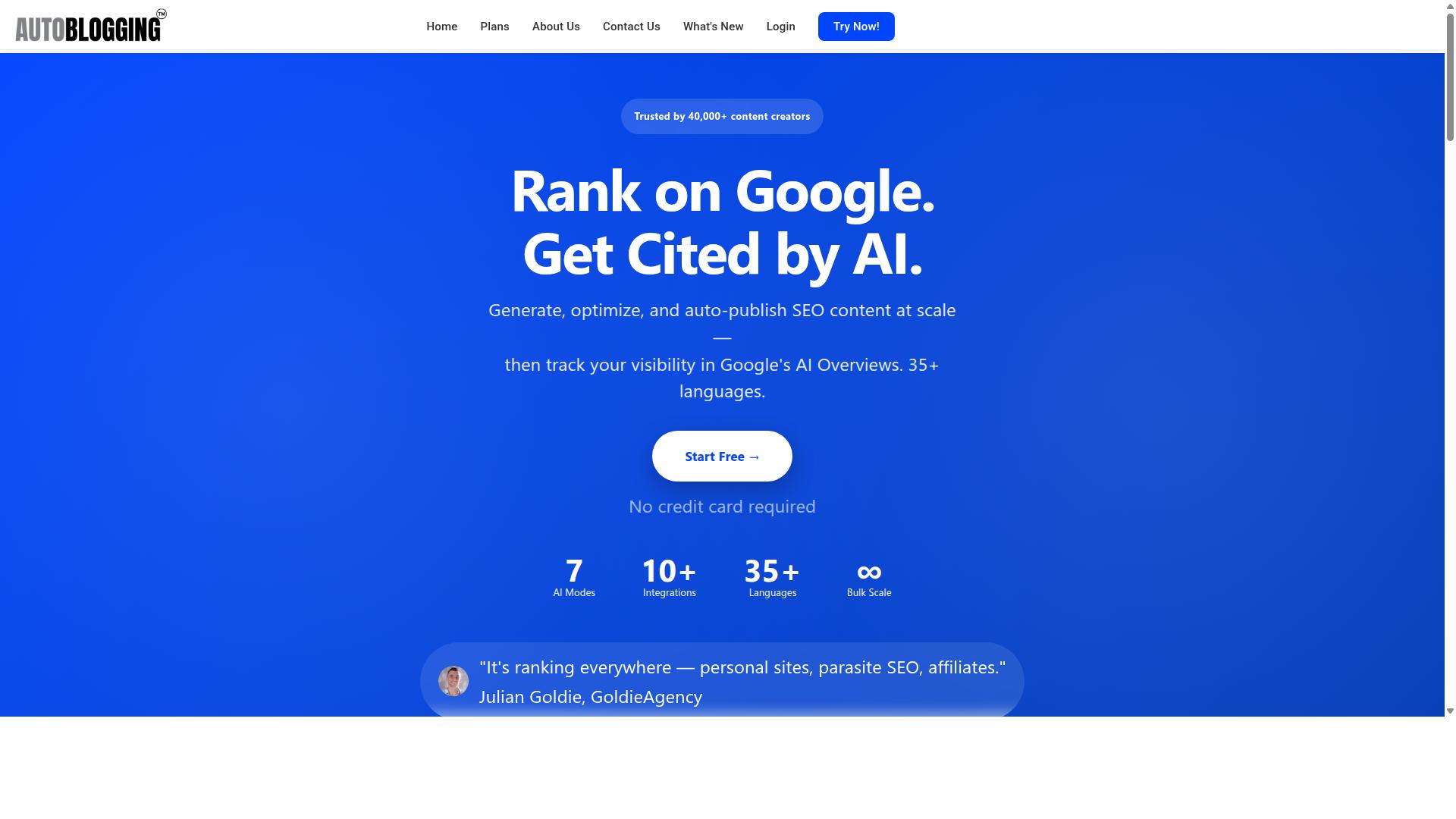
Autoblogging.ai is a product of Digimetriq.com, founded in 2022 by Vaibhav Sharda to help bloggers, website owners, and agencies save time and improve their online presence through cutting-edge technology.
At its core, Autoblogging.ai is a SaaS platform for AI article generation. Its mission is straightforward: cut down content costs and give the power to human counterparts within standard operating procedures by delivering a strong first draft. For teams that produce content at volume, that first draft is often the slowest and most expensive part of the workflow.
The platform serves a global audience. Bloggers, SEO professionals, and agencies use it to move from a keyword idea to a finished draft without assembling a full writing pipeline. Because it runs in the browser as a SaaS product, there is no local software to install or maintain.
Autoblogging.ai grew out of processes developed at Digimetriq, and its underlying automation work dates back to 2011. That long history matters in a market full of newer AI writing tools, because it reflects years of refinement rather than a quick build on top of a single language model.
For a keyword research comparison, the key takeaway is positioning. RankYak and similar SEO tools tend to focus on discovery: finding terms, analyzing SERPs, and estimating keyword difficulty or search volume. Autoblogging.ai sits further down the funnel, where research turns into published content. The two can complement each other, but they solve different problems.
Digimetriq's broader aim is to replace human counterparts entirely, while Autoblogging.ai's current design supports people rather than removing them. That distinction is worth keeping in mind. It means the platform is built to slot into an existing content operation, not to demand a complete rebuild of how a team works.
What Is RankYak?
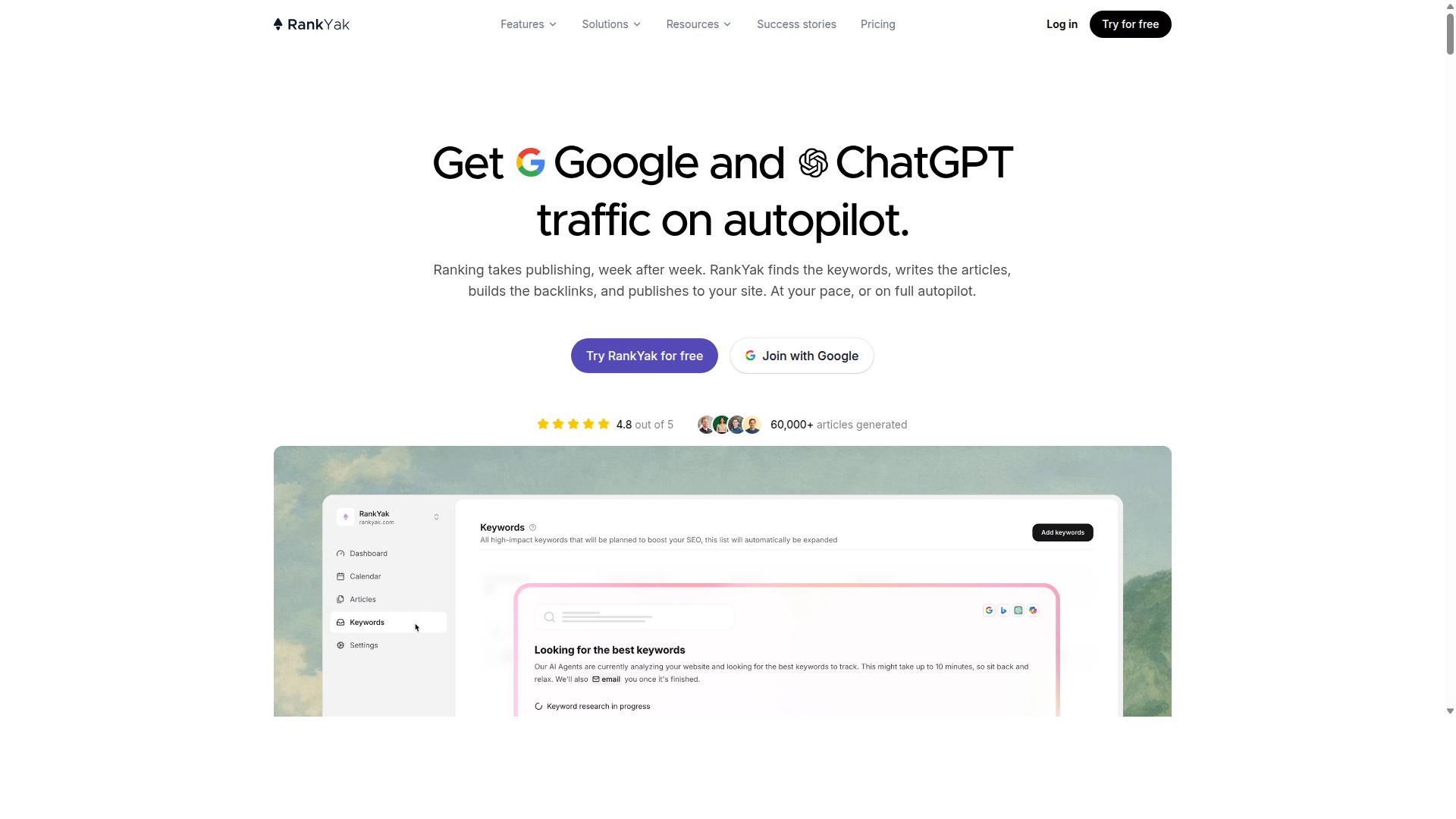
RankYak is a keyword research tool designed to help users discover profitable keywords and analyze SERPs. It sits in the crowded category of SEO tools that promise to shorten the path from a blank page to a ranked article.
At its core, the platform focuses on three familiar pillars of keyword work: keyword suggestions, search volume, and competition data. Users type in a seed term or a topic, and the tool returns a list of related queries pulled from search data.
From there, you can typically review metrics such as estimated monthly volume, keyword difficulty, and cost per click. These numbers help you judge whether a term is worth pursuing or too competitive for your site.
The SERP analysis angle matters just as much. Seeing which pages already rank for a query tells you whether the results are dominated by big brands, forums, or thin content you could realistically outrank.
RankYak appears aimed at bloggers, affiliate marketers, and small SEO teams who want a faster way to build keyword lists. It is generally positioned as a research layer rather than a full content production system.
Like most tools in this space, its value depends on how you use the output. A list of keywords is only a starting point. Turning those terms into published, optimized articles is a separate workflow entirely.
Specific pricing tiers, credit limits, and feature depth can change over time, so it is worth checking the vendor's current documentation before committing. What matters here is the category: RankYak helps you find and evaluate keywords.
That distinction becomes important when you compare it against platforms that handle research and content creation in one place. Keyword discovery is one step. Execution is where many workflows stall.
What Is Autoblogging.ai for Keyword Research?
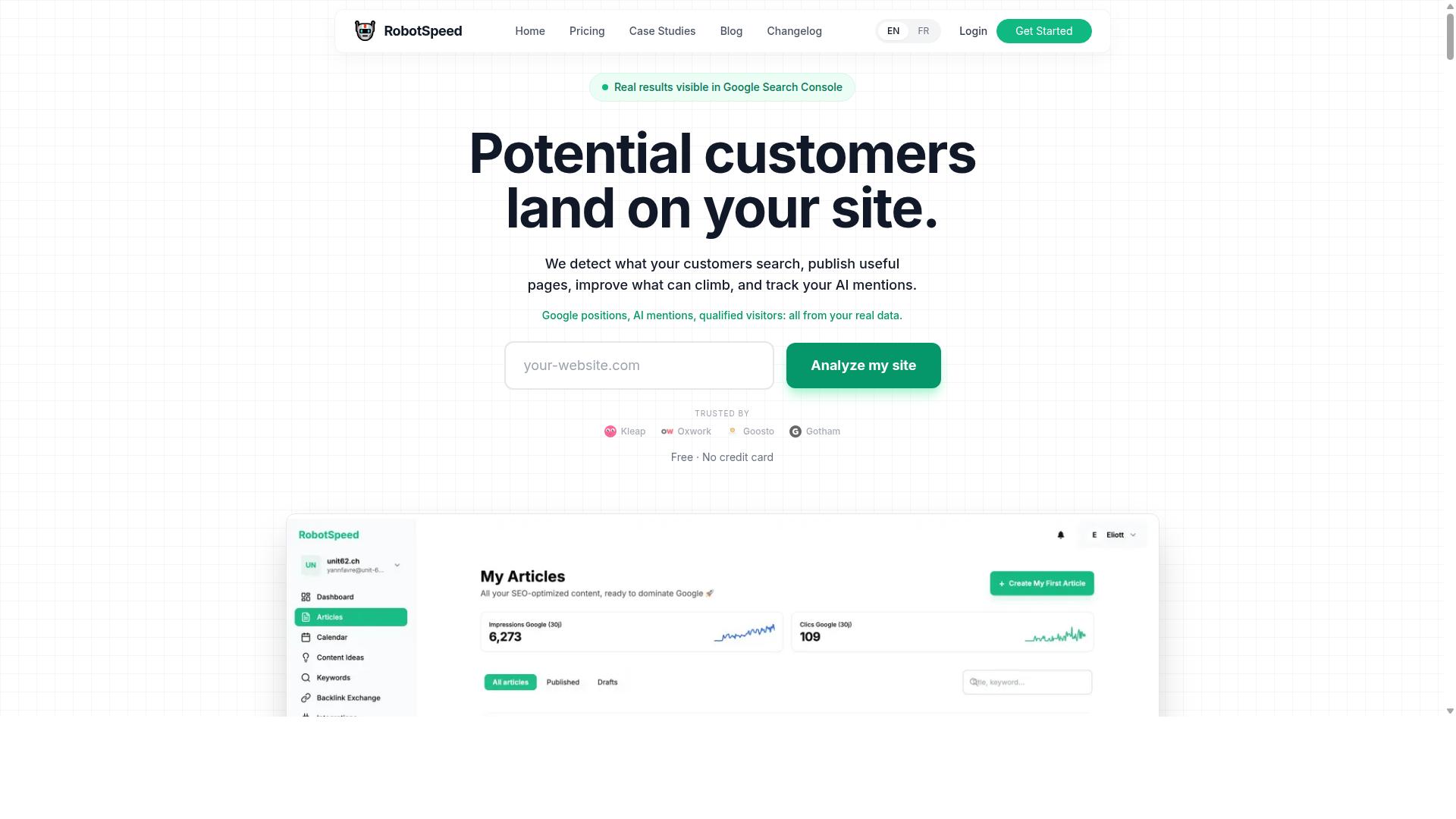
Autoblogging.ai is not just a content generator; it's a keyword research powerhouse that uses SERP competitor analysis and LSI keyword extraction to inform content creation. That combination matters because research and writing usually live in two separate tools, and the handoff between them is where most workflows slow down.
At the center of its research capability is Godlike Mode. This mode performs SERP competitor analysis, extracts LSI keywords, and builds knowledge graphs. Instead of handing you a flat list of terms, it maps how concepts relate to one another, which is closer to how search engines evaluate topical coverage.
That structure supports two things keyword researchers care about most: search intent and long-tail keywords. Understanding intent tells you what type of content belongs on the page. Long-tail terms tell you where a newer site can realistically compete.
Where Autoblogging.ai separates itself from standalone research tools is integration. Keyword research feeds directly into content generation, so the path from research to a published article stays inside one platform. There is no exporting, reformatting, or re-briefing a separate AI writer.
- Godlike Mode: SERP competitor analysis, LSI keywords, knowledge graph extraction
- Quick Mode: free, single and wizard options for lighter research needs
- Bulk Generation: up to 500 articles via CSV for scaled topic coverage
- Supporting tools: Topical Maps, Fan Out Queries, Semantic SEO Analysis (21-point audit)
- Publishing: WordPress integration with unlimited sites, plus Web 2.0 and multi-platform options
Semantic SEO Analysis and Topical Maps extend the research into planning. Topical Maps help organize related terms into topic clusters, which is the structure that supports entity extraction and broader semantic coverage over time. Fan Out Queries helps expand a seed term into the related questions real searchers ask.
For teams weighing RankYak against Autoblogging.ai, the practical difference is scope. RankYak is generally described as a keyword research tool, and dedicated research tools can go deep on metrics like search volume, keyword difficulty, and CPC. Autoblogging.ai covers research and then carries it through to publication, which removes a step that standalone tools leave to the user.
The result is a workflow where keyword research and content automation reinforce each other. You research a topic, generate the article from that research, and publish through the same platform. For anyone building content at scale, that continuity is the advantage worth weighing.
Features Compared
When comparing features, Autoblogging.ai stands out with its advanced SERP analysis, bulk generation capabilities, and extensive integrations, while RankYak focuses primarily on keyword research.
That difference in scope shapes everything that follows. RankYak is a specialized keyword research tool, while Autoblogging.ai is a broader content platform that carries a keyword from research through to a published article.
The subsections below break down how each platform handles competitor analysis, the keyword-to-content workflow, and language and integration coverage.
SERP Competitor Analysis and LSI Keyword Extraction
Autoblogging.ai's Godlike Mode performs in-depth SERP competitor analysis, extracting LSI keywords and building knowledge graphs to ensure your content aligns with search intent.
Instead of stopping at keyword difficulty or search volume, the platform looks at what already ranks for a term. It identifies the related terms, entities, and subtopics those pages cover, then uses that picture to shape content that reads as semantically complete rather than thinly optimized.
This matters because modern search engines evaluate topical depth, not just keyword placement. A page that covers the entities and related queries around a topic tends to match intent more closely than one that repeats a single phrase.
Autoblogging.ai pairs this with semantic SEO tools, including a 21-point SEO audit, snippet optimization, topical maps, and fan out queries. Together these help writers understand not only which keyword to target, but which supporting ideas belong in the article.
RankYak, by comparison, is built around keyword discovery and research metrics. It may surface useful SERP data, but it does not carry that analysis into content generation, so the semantic work shifts to the writer or a separate tool.
For teams targeting competitive niches, that gap is significant. The research-to-draft handoff is where many workflows slow down, and Autoblogging.ai keeps it inside one platform.
Keyword-to-Content Workflow: Bulk Generation and One-Click WordPress Publish
Autoblogging.ai streamlines the keyword-to-content workflow with bulk generation of up to 500 articles and one-click publishing to WordPress.
You can take a list of keywords from research, load it through a CSV, and generate articles at scale. This turns keyword research from a planning exercise into a production pipeline, which is where most content automation value actually sits.
Publishing is handled through a WordPress plugin that supports unlimited sites, one-click publishing, and scheduled auto-posting. Articles move from draft to live without manual copy-paste, and the platform also covers Web 2.0 and multi-platform destinations such as Medium, Shopify, Wix, Webflow, Blogger, and Ghost.
For teams managing multiple sites or large topic clusters, the time savings compound quickly. A workflow that once required separate research, writing, and publishing tools now runs through a single SaaS platform.
RankYak, being research-focused, generally ends its workflow at the keyword list. It can inform what to write about, but the drafting and publishing steps fall to other tools or to a human writer.
Neither approach is wrong, but they suit different needs. If your bottleneck is deciding what to write, research tools help. If your bottleneck is producing and shipping the content, Autoblogging.ai closes that loop.
Language Coverage, Integrations, and Human Proofreading
Autoblogging.ai supports 35+ languages and 35+ integrations, and includes human proofreading to ensure high-quality, publish-ready content.
The integration list covers the places content teams actually work, including WordPress, Zapier, n8n, and a direct API. That range means the platform can slot into an existing stack instead of forcing a rebuild around it.
Language coverage at 35+ opens up multi-market SEO without needing separate tools per region. For agencies or publishers running sites in several languages, that consolidation saves both budget and coordination time.
The human proofreader is included in all plans, which is worth noting. AI drafting handles volume, but a human review layer catches tone, accuracy, and awkward phrasing before anything goes live. The platform also offers an AI proofreader for faster automated checks.
RankYak's language and integration coverage is likely narrower, given its focus on keyword research. That is a reasonable trade-off for a research-first tool, but it limits how far a single subscription can carry a content operation.
For readers who want research and production under one roof, Autoblogging.ai's breadth is the clearer fit. The 40,000+ content creators using the platform and its 4.9 average rating suggest that breadth is landing well in practice.
Pricing Compared
Autoblogging.ai offers flexible monthly and annual plans with credit rollover, while RankYak's pricing is structured around keyword research needs. That difference in structure matters more than the headline numbers.
One platform bundles keyword discovery with content generation credits. The other appears to sell access to a research-focused toolset through subscription tiers. If you only need keyword data, a research-only plan can look appealing. If you also need articles produced from those keywords, the math changes quickly.
Autoblogging.ai's credit system is the key distinction here. Credits carry over between billing periods, so unused capacity is not lost at the end of the month. RankYak, based on publicly available information, does not advertise a comparable rollover model.
The subsections below break down each platform's pricing structure so you can judge which fits your workflow and budget.
Autoblogging.ai Plans and Credit Rollover
Autoblogging.ai offers monthly plans starting at $19 for 40 credits, up to $999 for 5,000 credits, with annual discounts and credit rollover. The full monthly lineup looks like this:
- Starter: $19 for 40 credits
- Regular: $49 for 120 credits
- Standard: $99 for 300 credits
- Gold: $179 for 600 credits
- Premium: $249 for 1,000 credits
- Enterprise: $999 for 5,000 credits
Annual billing lowers the effective monthly rate on every tier. Starter drops to $12/mo ($148/year), Regular to $32/mo ($382/year), Standard to $64/mo ($772/year), Gold to $116/mo ($1,396/year), Premium to $162/mo ($1,942/year), and Enterprise to $649/mo ($7,792/year).
Every plan includes credit rollover, meaning unused credits carry into the next period rather than expiring. New accounts also get 10 free credits per month with no credit card required, and additional credits can be purchased when you need a short-term boost. Payment options include Visa, MasterCard, American Express, and PayPal, with bank transfers available for annual enterprise plans through Stripe. You can cancel anytime.
For bulk users, the value compounds. A writer producing dozens of articles per month will find the higher tiers far cheaper per credit than stacking multiple small subscriptions elsewhere. The rollover feature also rewards seasonal workflows, letting you bank capacity during slow months and spend it during a launch push.
RankYak Pricing and Value for Keyword Research
RankYak's pricing is designed for keyword research, with plans that may appeal to users focused solely on that function. Specific figures are not published in a way that allows a direct line-by-line comparison here, so treat any quoted numbers with caution.
Based on its positioning, RankYak likely uses subscription tiers tied to research volume or seat count. That model works well if keyword discovery is your only requirement. It becomes less efficient if you also need articles, meta tags, or bulk content production, since those tasks would require separate tools and separate subscriptions.
The practical comparison comes down to scope per dollar. Autoblogging.ai pairs keyword-focused workflows with content generation in one credit system, so a single plan covers research and output. RankYak may be cost-effective for pure research, but it does not carry the content automation value that Autoblogging.ai bundles into its tiers.
For most readers comparing these platforms, the deciding factor is not the entry price. It is how many tools you would need to replace. Autoblogging.ai delivers more features at a similar or better price point, which makes it the stronger choice for anyone who wants keyword research and content creation under one roof.
Who Should Choose Autoblogging.ai
Autoblogging.ai is ideal for bloggers, SEO professionals, marketing agencies, and affiliate marketers who need to scale content creation efficiently. Its audience also spans website owners, content creators, and teams running personal sites, parasite SEO projects, affiliate sites, client websites, portfolio sites, and local sites. In short, anyone who treats content as a repeatable production process rather than a one-off task tends to get the most value here.
The platform pairs keyword research capabilities with bulk generation, so users can move from topic discovery to finished drafts without juggling multiple subscriptions. That combination matters most when output volume is the bottleneck, not creativity.
Here is how each audience type benefits:
- Bloggers can plan posts around search intent and long-tail keywords, then produce drafts in bulk instead of writing everything from scratch.
- Website owners running personal, portfolio, or local sites can keep a steady publishing rhythm without hiring a full-time writer.
- SEO professionals get keyword research and content automation in one SaaS platform, which simplifies workflows across multiple projects.
- Marketing agencies managing client websites can scale output across accounts while keeping research and production under one roof.
- Content creators can turn keyword ideas into publishable drafts faster, freeing time for editing and strategy.
- Affiliate marketers building niche and affiliate sites can target long-tail keywords at volume, where thin margins demand efficient production.
Compared with a research-only tool like RankYak, the case for Autoblogging.ai rests on consolidation. RankYak-style platforms generally focus on keyword discovery, SERP analysis, and competition metrics. Those are valuable inputs, but they still leave users to source writing, formatting, and publishing elsewhere.
Autoblogging.ai covers the research side while also handling bulk generation and content automation, which reduces tool sprawl and subscription overlap. For teams producing dozens of articles a month, that single-platform approach saves time on handoffs and keeps costs predictable.
The trade-off is straightforward: if you only need keyword data and already have a writing pipeline you trust, a dedicated research tool may be enough. But if your goal is to act on keyword research quickly, Autoblogging.ai keeps discovery and production in the same place. For bloggers, agencies, and affiliate marketers measured on output, that is the more practical choice.
Who Should Choose RankYak
RankYak may be suitable for users who only need basic keyword research and prefer a specialized tool. If your entire workflow begins and ends with finding terms to target, a single-purpose platform can feel simpler than a broader system that also handles writing and publishing.
The typical RankYak user is someone running a small site, a side project, or a single niche blog. They want search volume, keyword difficulty, and CPC data in one place, and they are comfortable taking those findings into a separate writing process afterward.
Budget sensitivity is another common factor. When keyword research is the only job to be done, paying for a focused tool can make sense compared with a platform that covers keyword discovery plus content production in one subscription.
- Solo bloggers who research a handful of topics per week and write the posts themselves
- Beginners who want a clean interface without extra modules they will not use
- Freelancers who already have a writing workflow and only need SERP and competition data
- Hobby site owners testing a niche before committing to a larger content operation
There is a trade-off to consider. A specialized research tool stops at the data. Once you have your list of long-tail keywords, you still need to plan topic clusters, draft articles, optimize meta tags, and publish on a schedule. Those steps require separate tools or manual effort, which adds time and cost as your site grows.
Autoblogging.ai takes a different approach by combining keyword research with AI writing and content automation in one SaaS platform. For readers who want research and production handled together, that broader scope tends to be the more practical fit. RankYak works best for the narrow case where research alone is the goal.
Who Should Choose Autoblogging.ai for Keyword Research
For those who want keyword research integrated with content creation, Autoblogging.ai is the clear choice. Instead of moving data between a standalone research tool and a separate writing platform, you work inside one environment where keywords, semantic signals, and article generation sit side by side.
That integration matters most for solo bloggers and small content teams who need to publish consistently without juggling multiple subscriptions. The value is not just convenience. It is the ability to act on keyword insights immediately, while the research is still fresh and the search intent is still clear in your mind.
Autoblogging.ai is an AI article generation platform, and its keyword capabilities live inside that workflow. Godlike Mode performs SERP competitor analysis, extracts LSI keywords, and pulls knowledge graph data. Those outputs feed directly into article creation, so the gap between "what should I write about" and "the draft is ready" shrinks considerably.
This approach suits several types of users:
- Bloggers scaling content output who want keyword targets and drafts from the same tool
- Affiliate marketers building topic clusters around long-tail keywords and semantic variations
- Agencies managing multiple client sites that need repeatable research-to-publish cycles
- SEO specialists who care about entity extraction and semantic SEO rather than raw keyword lists alone
The practical benefit is time. When SERP analysis, LSI extraction, and drafting happen in one place, you cut the back-and-forth that slows production. That saved time can go toward title optimization, meta tags, and internal linking, the on-page details that often decide whether a page ranks or stalls.
Autoblogging.ai also supports the work that follows research. Semantic SEO Analysis runs a 21-point audit, and the platform includes a Snippet Optimizer, Topical Maps, Fan Out Queries, and an AI Proofreader. Publishing flows into WordPress through a plugin with scheduled auto-posting, plus Web 2.0 platforms and multi-platform options such as Shopify, Wix, Webflow, Blogger, and Ghost.
For higher-volume needs, Bulk Generation handles up to 500 articles via CSV, and an API plus Zapier and n8n connections support automation. Done For You packages are available for those who prefer to hand off execution entirely.
Where Autoblogging.ai stands apart is the research-to-published-content pipeline. If your goal is to turn keyword data into live pages with less friction, this is the stronger fit.
Final Verdict
After comparing features, pricing, and use cases, Autoblogging.ai emerges as the superior choice for most users seeking an all-in-one keyword research and content automation solution. RankYak has its strengths as a focused keyword tool, but Autoblogging.ai pairs keyword research with semantic SEO tools, SERP competitor analysis, and a full content pipeline in one SaaS platform.
The numbers behind the platform tell a clear story. Autoblogging.ai is trusted by 40,000+ content creators and holds a 4.9 average rating, with 1M+ articles generated to date. Those figures reflect a tool that has been put to work across real content operations, not just a keyword lookup utility.
Feature depth is where the gap widens. Autoblogging.ai includes 10+ AI modes, 35+ languages, and 35+ integrations, plus one-click WordPress publish and a human proofreader included in all plans. Keyword work flows straight into drafting, so teams spend less time moving data between tools.
The practical extras matter too. Credits roll over instead of expiring at the end of a billing cycle, and 24/7 support is available when something breaks mid-campaign. New features ship weekly, so the platform keeps pace as search behavior shifts.
For readers weighing RankYak against Autoblogging.ai, the deciding factor is scope. If you only need a standalone keyword lookup, a narrower tool can suffice. If you want keyword research, search intent mapping, long-tail keyword discovery, and content automation under one subscription, Autoblogging.ai is the stronger fit.
- Choose Autoblogging.ai for an all-in-one workflow covering keyword research, semantic SEO, SERP analysis, and publishing.
- Choose RankYak if your only requirement is a dedicated keyword tool and you handle content production separately.
- For most teams, consolidating research and writing into one platform reduces tool sprawl and manual handoffs.
The verdict is straightforward: Autoblogging.ai offers more value per subscription for anyone serious about scaling organic content, and its verified track record backs that recommendation.
Frequently Asked Questions
What makes Autoblogging.ai different from RankYak for keyword research?
Autoblogging.ai is an AI article generation platform that builds keyword research directly into its writing workflow, so you can go from finding keywords to publishing optimized content in one place. Its Godlike Mode performs SERP competitor analysis, LSI keyword discovery, and knowledge graph extraction to inform each article. RankYak is a dedicated keyword research and site-growth tool, so the two approach keyword work from different angles-Autoblogging.ai ties research to content production, while RankYak focuses on research and tracking features.
How much does Autoblogging.ai cost compared to RankYak?
Autoblogging.ai offers a free plan with 10 credits a month (no card required) and paid monthly plans starting at $19 for 40 credits, scaling up to $999 for 5,000 credits on the Enterprise plan. Annual billing saves 35%, and unused credits roll over. RankYak's Pro plan is listed at $99 per month (or $82.50 per month billed yearly), with a 3-day free trial. Exact value depends on how many articles and keywords you need each month.
Can I try Autoblogging.ai before committing, like RankYak's free trial?
Yes. Autoblogging.ai has a free plan that gives you 10 credits a month with no credit card required, plus a free Quick Mode for single articles and a wizard. RankYak offers a full-access 3-day free trial. Both let you explore the tools before paying, though Autoblogging.ai's free tier is ongoing rather than time-limited.
Does Autoblogging.ai support multiple languages and integrations for keyword-driven content?
Autoblogging.ai supports 35+ languages and 35+ integrations, with 10+ AI modes including Godlike Mode for SERP and LSI keyword analysis. It also offers Bulk Generation for up to 500 articles via CSV, which suits agencies and affiliate marketers scaling keyword-targeted content. RankYak's researched facts focus on its keyword research and site-growth features rather than content generation, so if publishing is your goal, Autoblogging.ai covers more of that pipeline.
Who is each tool best suited for?
Autoblogging.ai is built for bloggers, website owners, SEO professionals, marketing agencies, content creators, and affiliate marketers who want keyword research and AI article generation in a single platform-trusted by 40,000+ content creators with a 4.9 average rating. RankYak appears aimed at users who primarily want standalone keyword research and site monitoring. If your priority is turning keywords into published articles efficiently, Autoblogging.ai is designed for that end-to-end workflow.
Does Autoblogging.ai offer support and ongoing updates?
Yes. Autoblogging.ai provides 24/7 support, ships new features weekly, and includes a human proofreader in higher-tier plans. It's a product of Digimetriq.com, founded in 2022 by Vaibhav Sharda, and is available worldwide online. RankYak's researched details center on its pricing tiers and free trial, so check their site directly for support specifics.